
Culture as a Competitive Advantage
Assimilation is yesterday’s thinking. Smart businesses don’t replace culture, they nest an identity that is cooperative and collaborative.
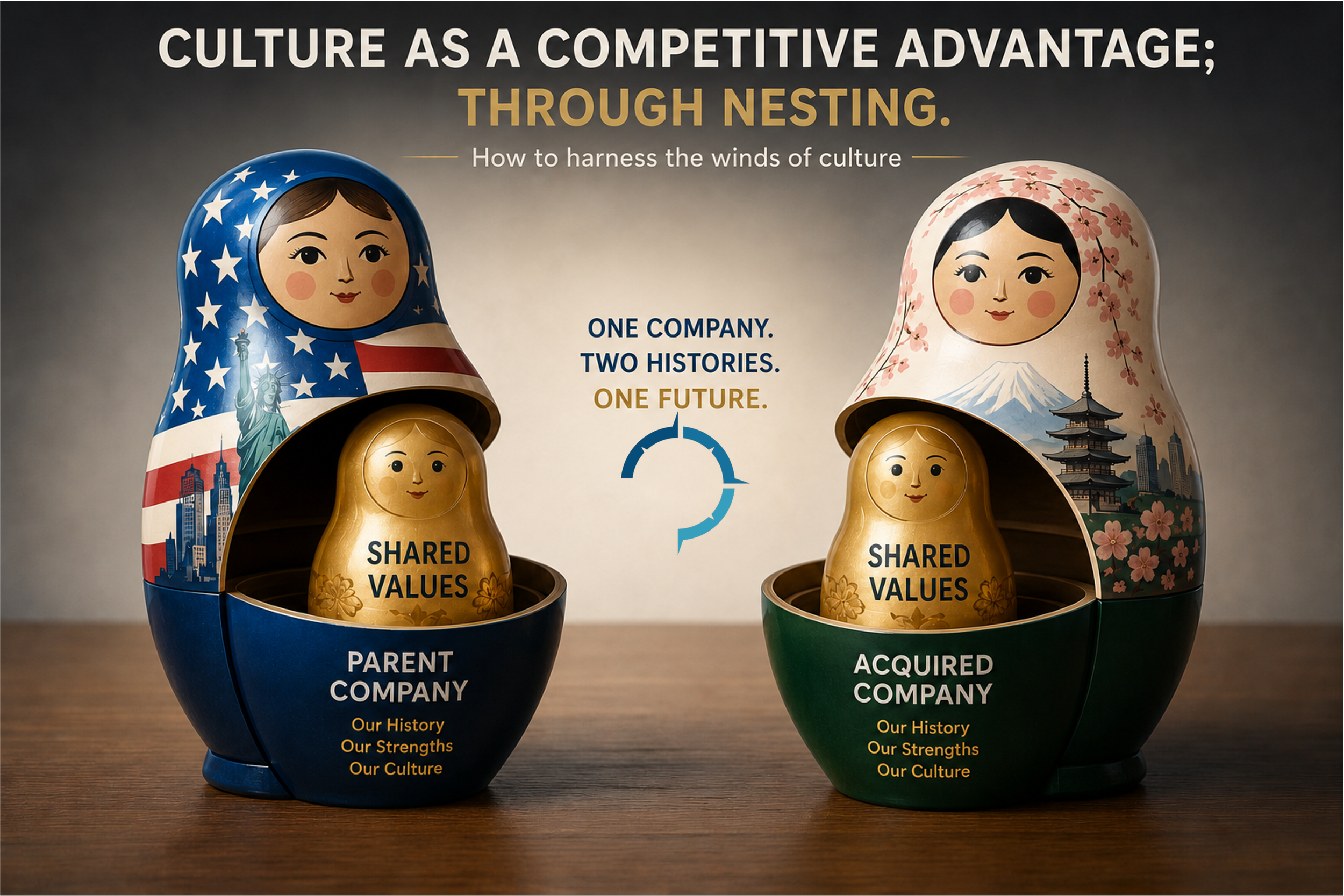
GALE Force - how to harness culture as a competitive advantage
Ask most sponsors or executives whether culture matters, and they’ll say yes before you finish the question. Ask them what they plan to do about it, and the answer is usually some version of the same mistake: change it. Roll out new values. Rewrite the handbook. Announce a culture initiative with a catchy name and a kickoff deck.
It rarely works. And it’s naive to expect otherwise.
Culture was here before you arrived, and it will be here after you leave. It doesn’t answer to a strategic plan, and it doesn’t care about your company or your quarter. Local culture, company culture, the culture a business has carried for eighty years through three ownership changes — you don’t overwrite that.
Culture is a powerful weather system. It should be understood first, on its own terms. Then you look to harness its strength as a competitive advantage.
The Week Culture Won
I learned this the hard way in Chile.
I’d flown down for a critical week of meetings, the centerpiece being a sit-down with BHP Escondida — the largest mining operation in the country. We’d prepared for weeks. I arrived at their Antofagasta regional headquarters ready to make the case.
The building was nearly empty. Chile had just advanced to the Copa semifinals against Peru, and everyone who could get in front of a television had done exactly that. Weeks of preparation, dwarfed by ninety minutes of football. Chilean culture won.
I had a choice: fight the culture or use it. It wasn’t a hard call. The next time Chile advanced in the Copa, we didn’t compete with the celebration — we built one. We cleared out the shop floor, bused in families, put up a big screen, and threw a barbecue for employees and customers alike. Between 2016 and 2020, we doubled a business that had been growing in the high single digits. Two things made that possible: we figured out what genuinely motivated our people, and we built it into the fabric of the company instead of scheduling around it.
Culture has Momentum, Like a Wheel. Make it a Slogan and it will steamroller you.
That COPA afternoon taught me something bigger than soccer. Culture isn’t a mood or a poster on the wall — it’s machinery. I picture it as a wooden wheel with spokes: the stories people tell about themselves, the unspoken rules everyone already knows, the humor that only lands in the local language, the rituals that quietly structure a day. Every spoke carries real load. Every market on earth has tuned that wheel differently.Try to run against it, and you’ll get crushed beneath its momentum. But study the spokes — their weight, their history, what’s nonnegotiable to the people who live inside them — and the wheel becomes something you can build alongside, rather than something that flattens you.There’s a martial art principle for this. A colleague once explained the Japanese martial art Aikido to me: true power doesn’t come from resisting force, it comes from redirecting it. You meet the opponent’s energy, align with it, and channel it toward a constructive end. That’s precisely what a Nested Culture requires. You don’t cancel the local current. You read it, and you let it carry you forward.
Nesting a Culture, Not Replacing One
Here's the distinction that separates leaders who succeed across borders from the rest: identity is what must be true everywhere. Practice is how it becomes true locally. Leaders who honor that distinction build something durable — a culture that travels. Blur it, and you either import a foreign culture that never takes root, or splinter into a dozen disconnected ones with no throughline at all.The answer is a nested culture — a small set of values, defined plainly, that flex in expression from Santiago to Turin to Wyoming while holding firm on what they mean. At one company I led, our red lines came down to five commitments: respect, honesty, safety, integrity, and unity across teams. Everything else — how people greet each other in the morning, how a holiday gets celebrated, how directly feedback gets delivered — belonged to the local culture to shape.That's the whole strategy.The Human Truths Underneath It AllOnce you stop trying to overwrite culture and start building inside it, something interesting happens: the differences shrink. Patrick Lencioni has spent a career studying why people disengage at work, and he traces it to three root causes — anonymity, irrelevance, and the absence of feedback. People need to feel known. They need to understand why their work matters. And they need a way to tell whether they’re winning.Those aren’t Chilean truths or Italian truths or American truths. They’re human ones. I’ve watched employees in five different countries respond to the exact same three levers — belonging, meaning, and feedback — because underneath every local wheel of culture is the same bedrock of human nature. You don’t have to change a country’s culture to reach it. You have to be fluent enough in that culture to deliver belonging, meaning, and feedback in a form the people in front of you actually recognize. The Gale Is Already Blowing“The winds of culture are unstoppable. You don’t stop a gale force wind -— you harness it.”
From G.A.L.E. Force: Navigating Strategy, Culture, and Value Creation in Modern M&A is a 2026 release by J. Michael Coffey, published by Entrepreneur Books
That’s the idea at the center of my forthcoming book, GALE Force — Global Aim, Local Execution. A sailor doesn’t get to choose the wind. They adjust their rigging, sails and boat to win. All companies face the same choice every day, in every market they enter: fight the local wind, or trim toward it and let it drive you forward.
Bottom Line
You cannot change culture, and pretending otherwise is where most leadership initiatives quietly die. What you can do is understand it deeply, define the handful of things that are truly nonnegotiable, and then build a nested culture that lets local truth and global ambition move in the same direction. Do that, and the winds that once looked like a headwind become the very force that carries the company forward.
GALE Force releases soon — and this idea, culture as a competitive advantage rather than a compliance exercise, runs through the entire book.
— J. Michael Coffey
MICHAEL COFFEY is a global executive and M&A strategist with over thirty years of experience leading growth, integration, and cultural alignment across industrial markets. He served as CEO of H-E Parts International and Manitex International, guiding more than thirty-eight acquisitions across four continents. Known for his ability to scale businesses through local execution, Coffey specializes in post-merger integration, leadership development, and platform strategy. He holds an MBA from Emory University and a B.S. from Nyack College. He lives in Atlanta, Georgia.
https://www.jmichaelcoffey.com/about
